
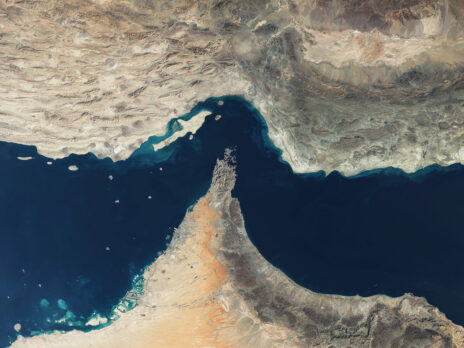
As the UK braces itself for the oil shock waves racing towards its shores, Donald Trump appears to be contemplating a ground invasion of Iran in order to pressure the regime to fully re-open the Strait of Hormuz. That is if he doesn’t abandon the war altogether.
The US president’s recent messaging on the war, fired off via social media posts, has been wildly incoherent. On 31 March, he posted that countries like the UK were on their own: “You’ll have to start learning how to fight for yourself, the U.S.A. won’t be there to help you anymore, just like you weren’t there for us. Iran has been, essentially, decimated. The hard part is done. Go get your own oil!”
Meanwhile, roughly 50,000 American troops are waiting in the Middle East, infrastructure across the Gulf is still being bombed, and the global economy is increasingly strained.
To help make sense of the chaos, the New Statesman spoke to Nicholas Mulder, an assistant professor at Cornell University and the author of The Economic Weapon: The Rise of Sanctions as a Tool of Modern War, about the US’s strategy, what might entice Iran to open the Strait of Hormuz, and what European countries should be doing to navigate the crisis.

Megan Gibson: You and others have observed that the disruption of the Strait of Hormuz was a contingency that American officials have been aware of for decades. So why was Trump’s administration caught off guard by the fact that its war on Iran led to… the disruption of the Strait of Hormuz?
Nicholas Mulder: I think we don’t know the full answer yet because we need to figure out what has been going on inside the American government. But my general impression is that people in parts of the American government are scared to speak their minds when they feel that the answer will not be to Trump’s liking. But of course it is the job of people who plan for these sorts of eventualities to forecast exactly this scenario. The question is whether the people who were warning about this were sidelined – whether they were perhaps removed from government or left themselves because there were a lot of high-level firings in the US military establishment last year.
My sense from talking to people who have covered this administration is that there’s been a big culture of political loyalty enforcement and fear. So the people that were providing briefings were not quite as outspoken as previous experts and generals who would’ve been in highlighting this risk. Or if they did, perhaps they were simply overruled by the political decisionmakers. In the United States there is of course a very strong tradition of civilian control over the military. And Trump has really exploited that to the hilt in a way where he tried to make sure that the military toes his political line.
The other thing that I think has played a role in this war is the very striking speed and I guess relative success by their metrics, of the operation to kidnap Maduro in Venezuela. The decision to start reinforcing military forces in the Middle East was taken in the days after the Venezuela operation. I imagine that there was quite a euphoric mood [within the administration]. The assumption was likely that they could replicate the success of what they had done in Venezuela in Iran.
As a historian, that is an extremely recognisable phenomenon: that an unexpectedly quick success creates a false sense of confidence that is then applied to other situations where it is really not warranted.
Well hindsight is 20/20 but we can see now that the lessons they took from the strike on Venezuela were the wrong ones. And the lesson perhaps that they should have been looking for were found in what happened last year with China’s response to the US’s tariffs and trade war, when China proved its ability to impose its own economic retaliation against the US.
Yes, absolutely. I think that [any kind of economic retaliation was] one thing that they did not really take into account. I think the other thing is the fact that when the 12-Day War happened last year in June, there was very little turmoil in the oil market. Quite remarkable actually, in retrospect. And part of that was the fact that, of course, Iran did not close the strait [then].
Chris Wright, the Energy Secretary, has said in the last few months that they were confident that they could weather the oil market impact based on what they had seen from last year. So they drew the wrong lesson. And the conflict now is of a completely different order and scale.
Obviously America has been caught quite off guard about how resilient Iran has been, not just in terms of its ability to close off the Strait of Hormuz and cause economic damage to the globe, but also the resilience of its military, especially in the wake of years of punishing sanctions. Do you think that America – and the West more broadly – has been too complacent about the effectiveness of sanctions as a tool?
I think that the thinking indeed has been that sanctions would simply degrade Iran’s economic power. And they have been a tremendous burden. But the problem was that that never produced a softening of political relations and they in fact empowered the hardliners on the Iranian side. That’s the counterproductive nature of the sanctions that have been in place on Iran since 2018, when Trump withdrew from the JCPOA, the Iran nuclear deal. Under Biden, sanctions remained on the books, but in practice, the Biden administration made it clear that they weren’t really going to enforce them because they actually wanted Iranian oil to keep flowing to Asia [when the West] was putting huge sanctions on Russia over Ukraine. When Trump came into office again last year, he really tried to increase pressure again.
But the problem with these sanctions is that they never brought us to a better political reality in which it was possible to really negotiate in good faith with Iran. Sanctions were seen as an instrument that was doing the job of containment very well. The [thinking became]: why would we need a deal when essentially they are slowly growing weaker? I think that’s a quite common view in the US. But over time, as you impose all these sanctions on Russia and Venezuela and Iran and North Korea, the targets of all these sanctions began to cooperate with each other. They have this shadow fleet that trades their oil among themselves and to other parts of the world, particularly Asian economies. And it’s a quite substantial part of the internationally traded supply of oil. It actually has become much more difficult to apply oil sanctions effectively against more than one country at the same time because as you try to ratchet up pressure on one, you’re probably going to have to dial it back on another simply to make sure that the oil prices for your own economy don’t blow up in your face.
This administration just failed to foresee that completely. It has now been forced to improvise in this really incoherent way where they have lifted the sanctions on Russian oil and lifted the sanctions on Iranian oil, and are now essentially using this shadow fleet as an extension of their own strategic petroleum reserve.
How effective do you think Trump’s social media posts hinting at an imminent end to the war have been on calming markets? And is it going to remain effective?
He has very clearly been trying to talk down the price of oil. He has been delivering these really ambivalent messages, on the one hand threatening incredible escalation, and on the other saying that he thinks a deal’s close. Over the last month it worked. But this week, you could see – as we are all glued to our screens waiting for the futures markets to open right after eating our Sunday roasts – that effect [of his posting] is starting to fade. I think the markets and the traders have woken up to the fact that they are being taken for a ride and that this is an attempt to manipulate sentiment. There seems to be definitely also short selling going on and insider trading [by those in government] that absolutely should be investigated but is not. And strikingly even the speaker of the Iranian parliament Mohammad Bagher Ghalibaf has tweeted about this, saying if you see attempts to talk the market down, go long. So even the Iranians have now begun to call this out.
I think that in the next week or two we’re also going to see really serious physical shortages. The last vessels to go through the Strait of Hormuz before the war started [their journey] on 28 February and are getting to their ports about now in most Asian economies. So this gap is going to hit the supply chain, and people [and markets] are now going to really look at the physical realities rather than the just tweets.
I think many people have now seen the map from JP Morgan analysts that shows the dates of when this “gap” as you describe it will hit different regions. And yes, starting this week it will be Asia, from 10 April it will be Europe.
Exactly. It is almost a little bit like waiting for Covid in February 2020, right? It was also very much about: Where will it spread? What are the areas where it will hit first? And then how far behind them are we? It’s the same really eerie sense of an impending shock about to hit you.
So I think that [Trump’s social media posts are] not going to be very helpful anymore for the US going forward. The broader question is what can they credibly offer Iran that would lead the Iranians to agree to end this war? They have so little credibility left and once you attack [another country] during negotiations – or even try to take out your negotiating partners – it becomes very difficult to reassure people.
The [goal] now is to try and figure out how we get out of this. Iran has established a measure of deterrence not just with Hormuz, but also by continuing to launch ballistic missiles and drones at fairly steady rates. So basically it’s going to be a balance between deterrence of those coercive instruments and military instruments, and on the other hand, reassurance. And that’s what’s often missing in debates about security and geopolitics – we all talk about deterrence, but we’re actually very bad at thinking properly about how you construct and ensure reassurance that you are not going to be doing something coercive in the future.
And it’s also difficult because it involves two parties here – it’s not just the US, it’s also Israel. So it requires Trump to not only say that he will not [continue striking], but that he can also guarantee to the Iranians that the Israelis will not [strike] either. That raises all sorts of questions about the degree to which he can make Israel do what he wants. That’s also very much an open question.
Have you seen anything that leads you to believe that there is a path out of this? What could the US offer? I realise this might be too speculative a question at this point.
Well, it is speculative, but I think that we should probably speculate because we need to think about the best possible futures. The Trump administration has already given [some degree of] sanctions relief now to Iran, which is quite striking. [But the US could offer further relief that is] much more comprehensive: Western banks re-engaging, financial sanctions coming off investment. I think for a broad-based sanctions relief package, Iran would stop. It would be a kind of mutual economic disarmament. You could imagine that Iran would say, okay, we go back to free traffic through the Strait of Hormuz – but that is our economic stranglehold that we exercise [for reassurance].
There’s a kind of symmetry between those two things that I think could be the basis of a deescalation. It doesn’t have to be a complex, bloody, risky military operation to reopen the strait.
The other possibility is one where Iran trades its [control of] the strait for something more strategic in nature. One thing I could imagine is a demand that the US withdraw from any number of its bases in the Gulf. Now there are two reasons why I think that this is not so crazy [a suggestion]: one, we’ve seen that the US is now largely operating from bases much further away than the Gulf because they’ve had to evacuate most of them. Those bases have proven highly vulnerable to Iranian drones and missiles. They’re working with skeleton crews essentially: most of the personnel has checked into nearby hotels and is working remotely. You cannot run a military operations centre from a hotel room. These bases are not actually doing anything useful for the United States. They can’t really be used as a major air power projection site either because they’re within [Iran’s] missile range, and they’re being hit all the time.
And then second: you can imagine that Trump, who has in many ways thrown his allies in the Gulf under the bus, would be able to spin a withdrawal from the Gulf as a way of making the Arab states pay more for their own defense. It’s a bit like what he’s done with the Europeans, right? He could say, the United States actually got a better deal; we used to be securing these people and in exchange, they made us do all the heavy work – I have ended our allies free-riding.
With Iran then reopening the strait, you can see how both sides could portray that as a strategic gain and as a victory of sorts.
Those are the two options that I could see working. But obviously there are many political interests and many actors, I think on both sides that do not see things that way. And the question is just whether anyone in the United States is thinking far enough ahead and realising that there are only bad options going forward so it’s best to sort of cut our losses and, and do this deal now. But that requires a degree of rational sense that I think is in short supply at the moment.
Apart from the countries fighting this war, what can others do?
Initially there were some American commentators who tried to draw a difference between our sanctions and Iran’s blockades and economic weapons, saying we can be really precise in our sanctions, whereas Iran just hits everyone. But actually that’s not necessarily the case. Iran can and is concretely negotiating with ships from particular countries [for safe passage through the strait]. So they actually can exercise quite fine-grain control over who exactly passes the Strait of Hormuz and they have been letting through liquid propane gas tankers going to India and Pakistan. They’ve been letting Bangladeshi ships through, Chinese ships. They’re playing a very careful game to supply some of these really large populous Asian economies – often with large Muslim populations – to show that this is not an attack against Muslim countries, as such, but this is really against the United States and its allies.
I was going to ask if there is any hope for Europe. But, I guess… no.
I think the issue for Europeans is that we did not draw the right lessons from the 2022 Russian invasion of Ukraine and the following energy shock. The lesson of that should have been that depending on fossil fuel imports is extremely dangerous for your economy and for your political stability and for your social fabric. In every European country, affordability, the cost-of-living crisis, energy prices, electricity, fuel – it’s been the [most urgent] issue for voters for the last five years. It is absolutely a first order priority, no matter whether you’re left, right, centre.
But rather than draw that lesson that the problem is imported fossil fuels, we merely defined the problem as being dependent on Russian fossil fuels. And that seems to be such a self-deluding way of analysing the problem. We switched from being reliant on Russian pipeline gas delivered by Gazprom to instead having long-running contracts with Louisiana LNG providers, who are all Trump Maga aligned. The remainder [of European supply] is made up by Qatari LNG, and then countries like Algeria and Azerbaijan. It’s essentially just switching one kind of risk for another.
I think that the only way out is through. You can only do this by rapidly trying to diminish your across the board dependence on fossil fuels by all means necessary, and that involves renewables, energy efficiency, nuclear – all of it. It should just be an absolute priority. The countries that have put more effort into renewables or that have been good at not being fossil fuel-import dependent – so Spain, France and the Scandinavian countries, which have a lot of wind and hydro power – have substantially lower electricity prices and have electricity prices that are much less dependent on the price of imported gas. That’s clearly the way forward and I think that it’s going to be costly and difficult, but it’s really the only way to make it through the 21st-century geo-economic landscape. The longer that European leaders don’t convey that, the worse the situation.
In the UK there’s this political conversation at the moment where the strategy is avoiding panic. There’s real anxiety about sparking queues at petrol stations or people panic buying. But there’s also a sense that the government isn’t really preparing the population for what is coming.
It’s understandable of course, that you would want to stop any sort of snowball effect [and erode supply further]. But the lack of coherence in the European response [has been present] from the beginning. They’ve now begun to be more critical now that they’re seeing [the war could be] an absolutely catastrophic quagmire. I think Pedro Sánchez has really been an example. He’s speaking honestly to citizens about this [crisis], saying that we will not support this [war] and will invest in resilience and renewables and an autonomous strategy. I think he is much closer to the mean of European voters in all countries, actually, whether they’re left wing or right wing. Most of the population no longer thinks that an Atlanticist posture is helpful – it seems to just be a recipe for incredible risk to our own societies.
[Further reading: Nick Butler: We thought we could rely on an open energy market. This crisis will prove that’s not adequate]
Content from our partners

Related
Join the debate
Subscribe here to comment